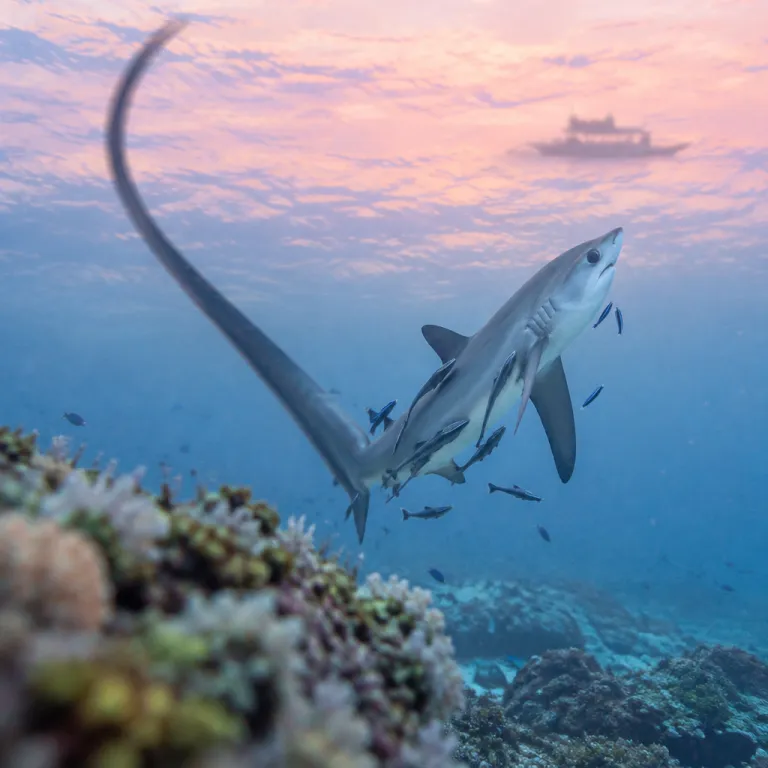
The pre dawn ritual at Monad Shoal
The alarm on Malapascua sounds long before the roosters. By the time you walk down to the sand, the dive center lights glow softly and divers move in practiced silence while the équipe checks every piece of equipment. This is malapascua thresher shark diving at its purest form, built around a single shoal and a single, unforgettable wildlife routine.
On the boat, dive guides brief the plan with calm precision and explain why Monad Shoal works as a cleaning station for pelagic thresher sharks. The seamount rises from deeper water to recreational depths, and at first light the thresher shark population comes up from the dark to let cleaner wrasse work along their flanks and tails. You will feel the evolution of the light above you as the sky brightens while the sharks glide in below.
The first malapascua dive of the day is usually the quietest. Divers sit on the gunwale, fins on, as the diving center crew calls the entry time and checks that every scuba tank and regulator is ready for the cold descent. When you roll back, the island vanishes and only the outline of the shoal and the expectation of sharks remain.
On the line with threshers, reef sharks and devil rays
At Monad Shoal, the etiquette is as important as the depth. You drop to the agreed ledge, settle behind the rope line that protects the cleaning station, and stay low while the first thresher appears from the blue with that unmistakable tail. Good buoyancy and calm breathing turn these dives into long, meditative encounters where divers thresher focused can watch the sharks circle without stress.
Most malapascua diving operations send experienced dive guides who know exactly where thresher sharks and reef sharks tend to pass. They will position you along the edge of the shoal so that sharks spotted by one group do not get chased by another, which keeps shark malapascua encounters reliable for everyone. When devil rays sweep in above the line, the scene feels like a slow motion ballet playing out over the reef.
Monad Shoal is not the only seamount here ; kimud shoal also offers pelagic action on the right day, with sharks and schooling fish over a white reef backdrop. Some dive centers schedule a second malapascua dive to kimud shoal after the main thresher dives, giving divers a sense of the wider evolution of the local ecosystem. If you are drawn to manta style gliding silhouettes, read the guide to immersive journeys for diving with manta rays across the world’s iconic waters on Blue Dive Adventures for a broader comparison of pelagic experiences.
Choosing a base, dive center and daily rhythm on the island
Malapascua is a small island, and almost every path eventually leads back to the beach and its dive shops. The scene runs from simple fan rooms to polished, low rise properties, but the real decision for scuba travelers is which dive center or diving center to trust with those pre dawn dives. Look for a PADI affiliated operation with a strong safety record, well maintained scuba equipment and a clear code of conduct for shark encounters.
Most malapascua diving outfits cluster along the main village beach, which keeps boat rides to Monad Shoal efficient and gives you time to sleep a little longer. A good dive center will offer small groups, clear briefings and dive guides who understand how to manage divers thresher focused without crowding the cleaning station. Ask how many dives they schedule daily at the shoal, how they rotate between dive sites such as Monad Shoal, kimud shoal and the local reef, and whether they cap numbers on each boat.
Reaching the island usually means a road transfer from Cebu to Maya, then a short banca crossing to malapascua, with the total durée depending on traffic and sea state. Once you arrive, the rhythm settles quickly into early nights, early starts and long surface intervals in the shade. For couples balancing romance with adventure, choose accommodation within easy walking distance of your preferred dive centers so that the pre dawn shuffle to the boat feels like part of the experience rather than a chore, and review ethical guidance such as the Blue Dive Adventures piece on the ethics of the whale shark encounter to frame your approach to shark malapascua tourism.
Beyond threshers: reefs, macro life and white reef walls
While malapascua thresher shark diving is the headline act, it should not be your only reason to pack a mask. The island sits close to a network of reef and wall dive sites where reef sharks, turtles and clouds of anthias work the current along white reef ledges. After the intensity of Monad Shoal, these more relaxed dives let you stretch bottom time and enjoy the evolution of color and coral forms.
Many dive centers will offer a three dive day that starts at Monad Shoal, continues to a local reef and finishes with a gentle macro focused malapascua dive. If you enjoy the patient search for tiny creatures, read the Blue Dive Adventures feature on why the world’s best tiny creature photography happens in the least glamorous sites, which pairs perfectly with the island’s critter rich sand patches. Scuba diving here can shift from pelagic silhouettes at dawn to nudibranchs and pipefish by afternoon, giving divers a sense of how one island can hold such different experiences.
Kimud shoal adds another layer, with schooling fish and occasional pelagic sharks over a plateau that feels wilder than Monad Shoal. Some dive guides like to finish a day there with a slow ascent along the reef, watching for devil rays and reef sharks that patrol the drop off. The more dives you log around the island, the more you will appreciate how malapascua diving offers both reliable thresher sharks and a broader, quieter reef story.
Conditions, experience level and conservation realities
Monad Shoal sits at a depth where solid buoyancy and gas management matter. Most malapascua thresher shark diving happens between about 18 and 30 metres, which means PADI Advanced Open Water or an equivalent certification is strongly recommended, and some dive centers will require it for the deepest ledges. Water can feel cooler at the shoal than around the island, so ask your dive center which wetsuit thickness their équipe suggests for the season.
Good operators structure dives to maximise time at the cleaning station without pushing no decompression limits, and they brief clearly on how long you will stay on the line. They also explain why strobes, chasing sharks or crossing the rope are not just bad manners but direct threats to the evolution of this unique shark malapascua economy. When divers respect the rules, thresher sharks and reef sharks continue to use the shoal naturally, and local communities retain a sustainable reason to protect them.
Every malapascua dive at Monad Shoal is a reminder that a single shoal can carry an entire island’s reputation. Choose dive shops that support local conservation initiatives, limit group sizes and train dive guides to intervene when etiquette slips. As more divers arrive and more dives are logged, the long term fidélité of thresher sharks to this cleaning station will depend on whether visitors value the health of the reef over the perfect photograph.
FAQ
What experience level do I need for Monad Shoal thresher dives ?
Most operators recommend that divers have at least PADI Advanced Open Water or an equivalent certification for Monad Shoal. The cleaning station ledges sit between roughly 18 and 30 metres, so you should be comfortable with deeper dives and solid buoyancy. Recent experience with similar depth profiles will make the pre dawn malapascua thresher shark diving far more relaxed.
How cold is the water during early morning thresher shark dives ?
Water temperatures around malapascua are generally warm, but the pre dawn dives at Monad Shoal can feel noticeably cooler due to depth and reduced sunlight. Many divers use a 3 mm to 5 mm full wetsuit, depending on personal tolerance and the time of year. Ask your chosen dive center for current temperature données before packing equipment.
Can non divers still enjoy Malapascua and its marine life focus ?
Non divers can enjoy the island’s beaches, boat trips and relaxed village atmosphere, but they will not see thresher sharks without scuba diving. Some centers offer PADI Discover Scuba Diving experiences that introduce beginners to shallow reefs under close supervision. For couples, this can be a way for one partner to sample scuba while the other pursues deeper dives at Monad Shoal.
How many days should I plan for reliable thresher shark sightings ?
To give yourself a strong chance of seeing thresher sharks, plan at least three to four mornings of scheduled Monad Shoal dives. Wildlife is never guaranteed, but malapascua is known for having thresher sharks spotted regularly at dawn thanks to the cleaning station behaviour. Extra days also provide a buffer for rough seas or unexpected cancellations.
Are cameras and strobes allowed during thresher shark encounters ?
Most dive centers allow cameras at Monad Shoal, but many strongly discourage or ban strobes and bright video lights near the cleaning station. Sudden flashes can disturb thresher sharks and reduce the quality of encounters for everyone. Follow your dive guides’ instructions closely ; responsible photography helps protect the long term reliability of shark malapascua diving.